
NGOs and the private sector : the state as an arbitrator ?
Brief published on Humanitarian Alternatives website on march 2018
The ICRC and partnerships with the private sector: evolution and ethical considerations
By Jessica Fleurinor and Caroline Putman Cramer – Jessica Fleurinor and Caroline Putnam Cramer invite us to an extension of the first part of our Focus theme. The International Committee of the Red Cross effectively did not have before the opportunity of presenting its approach to partnerships with the private sector. This is now the case, within a perspective going from the banker Dunant to the presence of the ICRC within the World Economic Forum (WEF) and comprising the Corporate Support Group especially created within the institution. [Read more]
Refugees wedged between corporate malfunctions and the lack of State involvement: the example of a cash programme in Cameroon
By Pierre Boris N’nde – Cash-transfer programmes are now widespread in humanitarian settings, just as partnerships with companies that promote them. Here is the case of the Gado Badzéré refugee camp in Cameroon. For Pierre Boris N’nde, the unsuccessful initiatives of Mobile Telecommunication Networks breached the “do no harm” principle and resulted in violence that was left for NGOs to manage. The Cameroon State, positioning itself in terms of security, here failed in its role as arbitrator. [Read more ]
“What’s important, is the mission and that everyone be inspired by common guidelines”
Interview with Patrice Paoli – Patrice Paoli is the director of the French Ministry of Europe and Foreign Affairs Crisis Centre. While the French State reaffirms its desire to involve companies and foundations in humanitarian action, it was essential to know more about this approach. For Patrice Paoli, it is based on pragmatism, collective action and the effective synergy of the means of each actor. NGOs now must position themselves according to this roadmap. [Read more ]
Social Impact Bonds or the pyromaniac State
By Joël Le Corre – The subject of “social impact bonds” was first raised by Mathieu Dufour in his article, “Are NGOs the sole purveyors of honourable intentions”, published in the previous issue of this review. Here, Joël Le Corre takes a closer look at this mechanism, examining it from the perspective of companies, which are the first to use it, focusing mainly on the State’s role in implementing a policy which, although innovative, is contested by NGOs.[Read more ]
Related Articles

How change happens in the humanitarian sector – CHS Alliance launches flagship report
10/04/2018. Two years after the World Humanitarian Summit in Istanbul, at which the humanitarian sector committed to substantial changes, the Alliance’s flagship report sheds light on what has happened, what not and why.
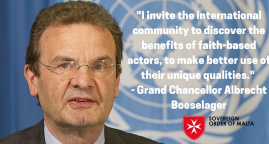
Highlights of the Sovereign Order of Malta’s participation at the WHS
05/26/2015. 9000 participants came together to reshape the field of humanitarian action.

How Environmental security and human rights are linked?
10/05/2017. According to experts, the natural resources and their fair distributions are essential to ensure the human rights.
